Medical supply samples are useful when they represent a defined product configuration and are reviewed against a controlled specification. Buyers should compare each requirement with sample results and supplier evidence, document deviations, and carry approved decisions into labeling, production, inspection, and shipment controls.
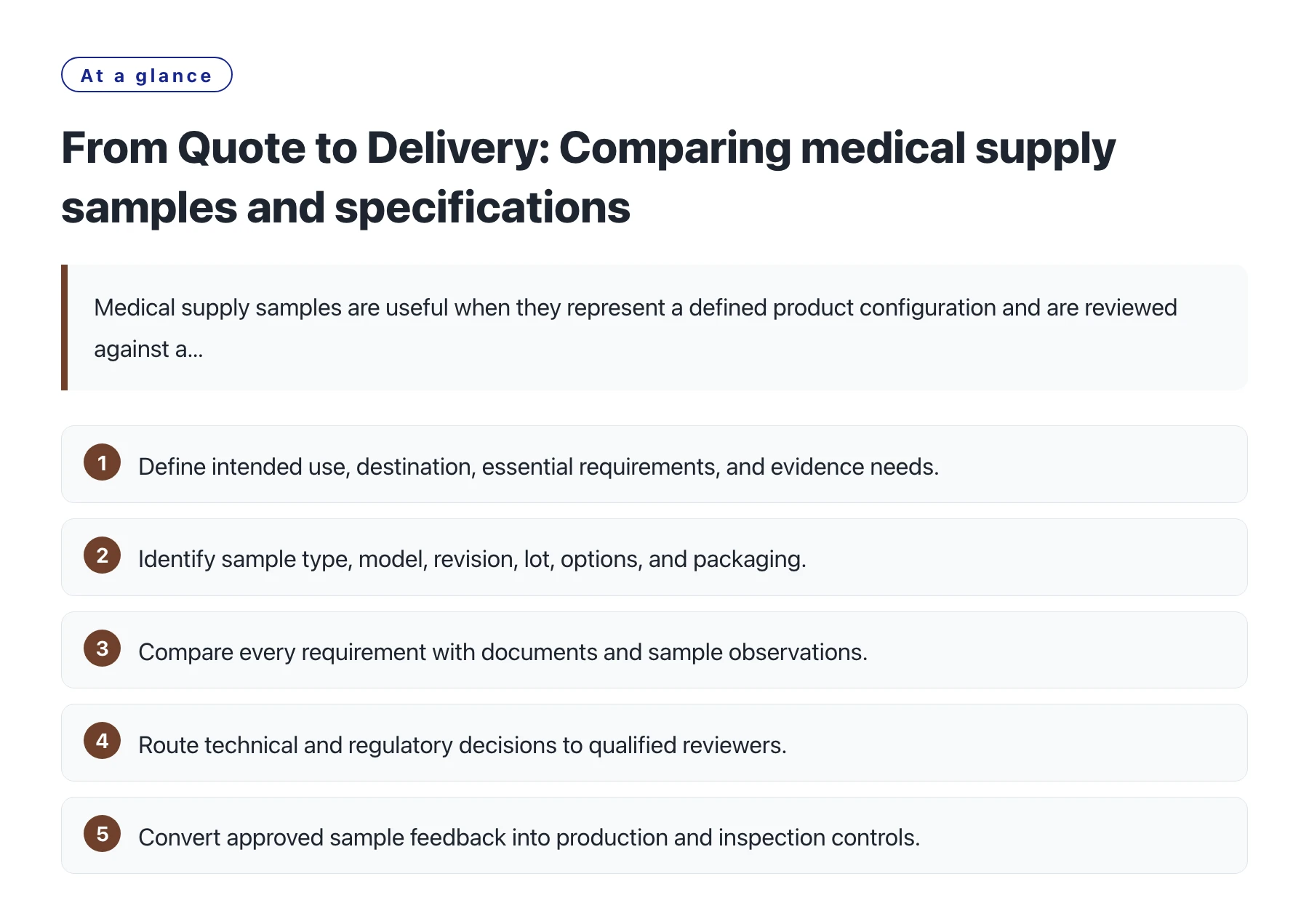
Key takeawaysDefine intended use, destination, essential requirements, and evidence needs. · Identify sample type, model, revision, lot, options, and packaging. · Compare every requirement with documents and sample observations. · Route technical and regulatory decisions to qualified reviewers. · Convert approved sample feedback into production and inspection controls.
A sample and a quotation can describe different products unless both are tied to one revision. A comparison matrix helps make those differences visible before order release.
Write the specification around use and acceptance
A medical supply specification should identify the intended use, product category, user, environment, quantity, packaging, storage, and destination. State measurable characteristics such as dimensions, material, connection, operating range, compatibility, or included accessories when they affect the buyer’s decision. Separate essential requirements from preferences so a supplier can explain a deviation clearly.
WHO notes that technical specifications can support procurement and acquisition of medical devices and help decision makers consider technical needs before purchase. Its guidance highlights that specifications inform implementation and resource planning as well as product selection.[1] Use a qualified clinical, biomedical, or regulatory owner to define product-specific requirements and confirm which destination rules apply.
Avoid relying on a generic product name, brochure, or photograph. Attach drawings or reference documents, assign a revision, identify approved equivalents, and state what evidence a supplier must return. The specification should make it possible to compare competing offers without letting each vendor define a different version of the product.
Ask for a sample that represents the offered configuration
Clarify whether a sample is a catalog unit, a modified prototype, a production-equivalent unit, or a packaging sample. Record model, manufacturer, options, materials, lot, date, firmware or software version when relevant, label revision, and included accessories. A sample cannot represent an unlisted configuration or process that it does not use.
Define what will be evaluated: identity, dimensions, assembly, function, user interface, connections, materials, finish, packaging, labels, instructions, or compatibility with another component. For attributes that require calibrated measurement, laboratory work, clinical review, or specialized expertise, assign the method and reviewer before the sample arrives.
Keep one approved reference with its sign-off record when practical. Include buyer, reviewer, date, outcome, accepted deviations, and production revision. If the sample is destructive or must be returned, state that in the approval plan and keep photographs or test records as appropriate.
Compare evidence with the specification line by line
Create a matrix with requirement, supplier response, sample result, document evidence, deviation, and disposition. Mark each point as verified, not verified, failed, or not applicable, and state who made the decision. This distinguishes a tested characteristic from an unverified statement or a visual impression.
Ask documents to identify manufacturer, exact model, configuration, standard or method, issue date, sample identity, and test laboratory where relevant. Confirm that evidence maps to the product being offered and the intended destination. A certificate, test report, declaration, registration, and marketing sheet are different document types; request the one needed for the decision and have a qualified reviewer interpret it.
If a supplier offers an equivalent, compare intended use, critical performance, materials, interfaces, labeling, service support, and required evidence. Document why the substitute is acceptable or reject it. Do not treat similar appearance or a shared product category as proof of equivalent function or compliance.
Review labeling, packaging, and usability
Inspect product and carton identifiers against the specification and quote. Check model, lot or serial marking, quantity, language, warnings, storage conditions, expiry information where applicable, and instructions. The regulatory owner should approve market-specific content; sample review should record whether the actual production label was present or a placeholder was used.
Assess packaging as part of the sample when transport or sterility matters. Define package layers, seals, protective materials, opening method, traceability, and handling instructions. A product sample in a showroom box may not represent production packaging or distribution protection. Ask how packaging changes are controlled and what validation or testing is relevant to the product.
For equipment that requires installation, power, consumables, calibration, training, maintenance, or software updates, review the required accessories and documentation. Confirm that the buyer can identify replacement parts and obtain service information. A sample that functions briefly may not demonstrate long-term support or suitability for the planned use.
Turn sample feedback into production controls
Write each correction as a specific requirement, not an informal comment. Identify affected drawing, component, label, or process; define the acceptance criteria; and request a revised sample if the change could affect fit, function, safety, or packaging. The supplier should acknowledge the revision before production release.
Create hold points for unresolved items. Decide whether ordering can proceed while a noncritical detail remains open, who accepts the risk, and what may not be produced until closure. Confirm that production, inspection, and procurement teams receive the same approved revision.
During production and before shipment, verify selected requirements against the agreed plan. Sampling can identify some nonconformities but cannot prove every unit or every hidden characteristic. Use qualified testing and risk-based inspection where needed, and record limitations with the report.
For medical supply manufacturers in China, buyers can request supplier coordination for specification questions, sample tracking, and document collection. Define the service scope and keep technical acceptance, market authorization, and final release with the designated qualified owner.
Sources
Frequently asked questions
Can a catalog sample be used for final approval?
Only if it represents the offered model and configuration. Record what differs from production and require a representative sample when a change could affect acceptance.
What should appear in a sample approval record?
Record model and revision, sample type, lot or date, review criteria, evidence, deviations, reviewer, outcome, and any conditions before production release.
Does passing a sample review confirm destination-market compliance?
No. A sample review is one input. A qualified regulatory owner should determine applicable rules and assess the required evidence for the actual market.
Should a supplier substitute require a new review?
Yes when the change affects a requirement, configuration, material, function, label, packaging, or evidence. Document the impact and approval before production.